
04
мар
Location of the Mariana TrenchThe Mariana Trench or Marianas Trench is located in the western about 200 kilometres (124 mi) east of the; it is the on Earth. It is crescent-shaped and measures about 2,550 km (1,580 mi) in length and 69 km (43 mi) in width. The maximum known depth is 10,984 metres (36,037 ft) (± 25 metres 82 ft) at the southern end of a small slot-shaped valley in its floor known as the. However, some unrepeated measurements place the deepest portion at 11,034 metres (36,201 ft). By comparison: if were placed into the trench at this point, its peak would still be over two kilometres (1.2 mi) under water.At the bottom of the trench the above exerts a pressure of 1,086 bars (15,750 psi), more than 1,071 times the at sea level. At this pressure, the density of water is increased by 4.96%.
The Mariana Trench, approximately 7 miles deep, lies in the western Pacific Ocean off the coast of Guam. Its deepest point, the Challenger Deep, has received.
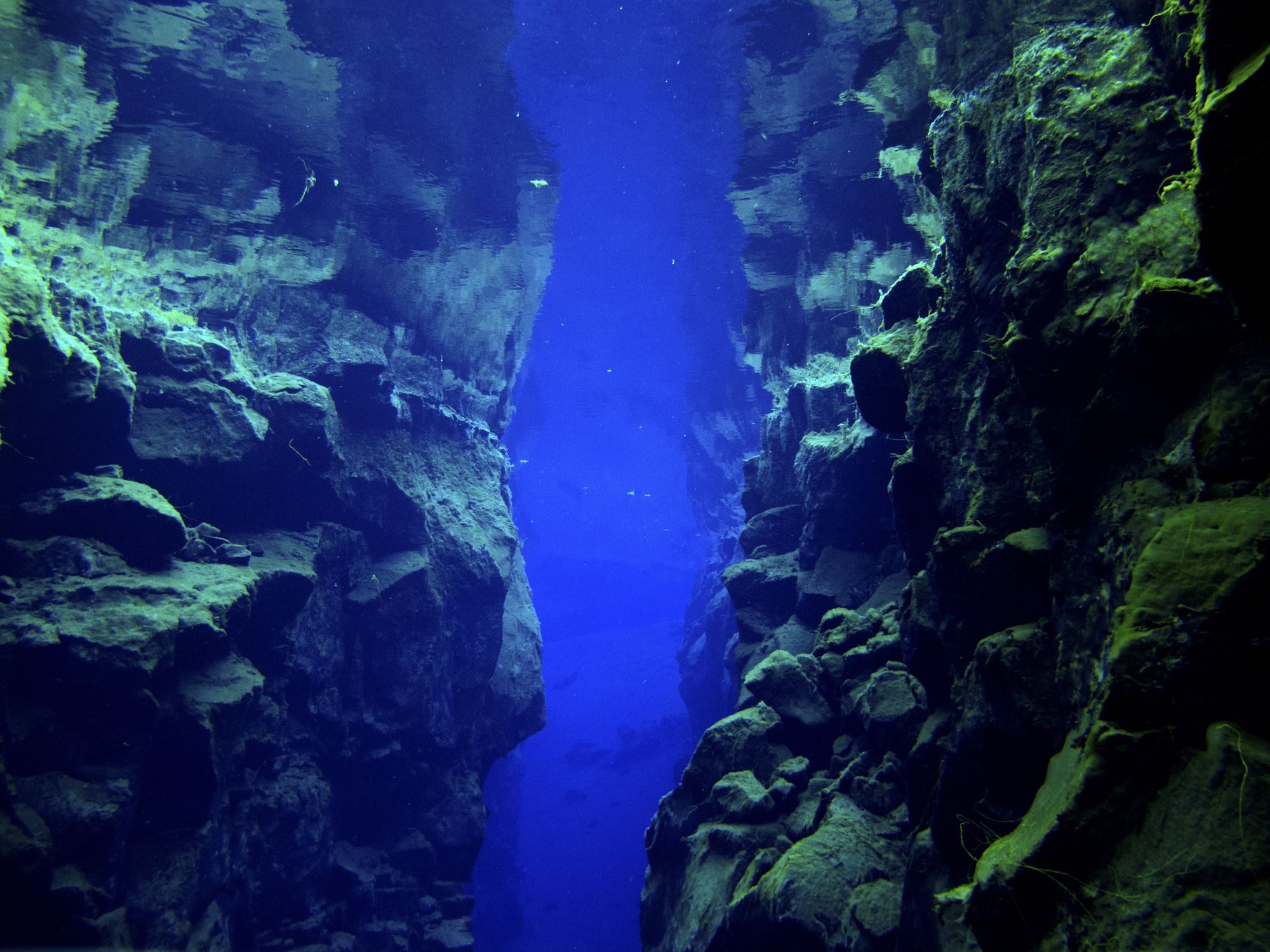
The temperature at the bottom is 1 to 4 °C (34 to 39 °F).The trench is not the part of the seafloor closest to the center of the Earth. This is because the Earth is an, not a perfect; its radius is about 25 kilometres (16 mi) smaller at the poles than at the equator. As a result, parts of the seabed are at least 13 kilometres (8.1 mi) closer to the Earth's center than the Challenger Deep seafloor. In 2009, the Marianas Trench was established as a. Have been found in the trench by researchers at a record depth of 10.6 kilometres (6.6 mi) below the sea surface. Data has also suggested that thrive within the trench. The Pacific plate is subducted beneath the Mariana Plate, creating the Mariana trench, and (further on) the arc of the Mariana Islands, as water trapped in the plate is released and explodes upward to form island volcanoes and earthquakes.The Mariana Trench is part of the system that forms the between two.
In this system, the western edge of one plate, the, is (i.e., thrust) beneath the smaller that lies to the west. Crustal material at the western edge of the Pacific Plate is some of the oldest oceanic crust on earth (up to 170 million years old), and is, therefore, cooler and denser; hence its great height difference relative to the higher-riding (and younger) Mariana Plate. The deepest area at the plate boundary is the Mariana Trench proper.The movement of the Pacific and Mariana plates is also indirectly responsible for the formation of the.
These volcanic islands are caused by of the due to the release of water that is trapped in minerals of the subducted portion of the Pacific Plate.Research history. See also:The trench was first during the in 1875, using a weighted rope, which recorded a depth of 4,475 (8,184 metres; 26,850 feet). In 1877, a map was published called Tiefenkarte des Grossen Ozeans ('Depth map of the Great Ocean') by Petermann, which showed a Challenger Tief ('Challenger deep') at the location of that sounding.
In 1899, a converted collier, recorded a depth of 5,269 fathoms (9,636 metres; 31,614 feet).In 1951, surveyed the trench using, a much more precise and vastly easier way to measure depth than the sounding equipment and drag lines used in the original expedition. During this survey, the deepest part of the trench was recorded when the Challenger II measured a depth of 5,960 fathoms (10,900 metres; 35,760 feet) at, known as the.In 1957, the vessel reported a depth of 11,034 metres (36,201 ft) at a location dubbed the Mariana Hollow.In 1962, the surface ship M.V. Baird recorded a maximum depth of 10,915 metres (35,810 ft) using precision depth gauges.In 1984, the Japanese survey vessel Takuyō (拓洋) collected data from the Mariana Trench using a narrow, multi-beam echo sounder; it reported a maximum depth of 10,924 metres (35,840 ft), also reported as 10,920 metres (35,830 ft) ±10 m (33 ft). Remotely Operated Vehicle reached the deepest area of the Mariana Trench and made the deepest diving record of 10,911 metres (35,797 ft) on 24 March 1995.During surveys carried out between 1997 and 2001, a spot was found along the Mariana Trench that had depth similar to that of the Challenger Deep, possibly even deeper. Neurovoider switch physical.
It was discovered while scientists from the were completing a survey around; they used a sonar mapping system towed behind the research ship to conduct the survey. This new spot was named the, after the group of scientists who discovered it.On 1 June 2009, sonar mapping of the Challenger Deep by the Simrad EM120 sonar multibeam bathymetry system for deep water, mapping aboard the (mothership of the Nereus vehicle), indicated a spot with a depth of 10,971 metres (35,994 ft). The sonar system uses phase and amplitude bottom detection, with an accuracy of better than 0.2% of water depth across the entire swath (implying that the depth figure is accurate to ± 22 metres (72 ft)).In 2011, it was announced at the Fall Meeting that a US Navy hydrographic ship equipped with a conducted a survey which mapped the entire trench to 100 metres (330 ft) resolution. The mapping revealed the existence of four rocky outcrops thought to be former.The Mariana Trench is a site chosen by researchers at and the in 2012 for a seismic survey to investigate the subsurface. Using both and the scientists are able to map structures as deep as 97 kilometres (60 mi) beneath the surface. Descents. The (designed by ), the first manned vehicle to reach the bottom of the Mariana Trench.Four manned descents and three unmanned descents have been achieved.
The first was the manned descent by Swiss-designed, Italian-built, -owned which reached the bottom at 1:06 pm on 23 January 1960, with and on board. Iron shot was used for, with gasoline for. The onboard systems indicated a depth of 11,521 m (37,799 ft), but this was later revised to 10,916 m (35,814 ft). The depth was estimated from a conversion of measured and calculations based on the from sea surface to seabed.This was followed by the unmanned in 1996 and in 2009. The first three expeditions directly measured very similar depths of 10,902 to 10,916 m (35,768 to 35,814 ft). The fourth was made by Canadian film director in 2012.
On 26 March, he reached the bottom of the Mariana Trench in the submersible vessel, diving to a depth of 10,908 m (35,787 ft).In July 2015, members of the National Oceanic and Atmospheric Administration, Oregon State University, and the Coast Guard submerged a hydrophone into the deepest part of the Mariana Trench, the Challenger Deep, never having deployed one past a mile. The titanium-shelled hydrophone was designed to withstand the immense pressure 7 miles under. Although researchers were unable to retrieve the hydrophone until November, the data capacity was full within the first 23 days. After months of analyzing the sounds, the experts were surprised to pick up natural sounds like earthquakes, a typhoon and baleen whales along with man-made sounds such as boats.
Due to the mission's success, the researchers announced plans to deploy a second hydrophone in 2017 for an extended period of time.achieved a new record descent to 10,927 metres (35,853 ft.), using the DSV Limiting Factor, a Triton 36000/2 model manufactured by Florida-based. He dived again in May 2019 and became the first person to dive the Challenger Deep twice. Planned descents. This section needs to be updated. Please update this article to reflect recent events or newly available information. ( December 2019)As of February 2012, at least one other team was planning a piloted submarine to reach the bottom of the Mariana Trench., a marine technology company based near and set up in 1992, plans for a crew of two or three to take 90 minutes to reach the seabed. Life The expedition conducted in 1960 claimed to have observed, with great surprise because of the high pressure, large creatures living at the bottom, such as a about 30 cm (12 in) long,.
According to Piccard, 'The bottom appeared light and clear, a waste of firm ooze'. Many marine biologists are now skeptical of the supposed sighting of the flatfish, and it is suggested that the creature may instead have been a. During the second expedition, the unmanned vehicle Kaikō collected mud samples from the.
Tiny organisms were found to be living in those samples.In July 2011, a research expedition deployed untethered landers, called dropcams, equipped with digital video cameras and lights to explore this region of the deep sea.Amongst many other living organisms, some gigantic single-celled amoebas with a size of more than 10 cm (4 in), belonging to the class of were observed. Monothalamea are noteworthy for their size, their extreme abundance on the seafloor and their role as hosts for a variety of organisms.In December 2014, a new species of was discovered at a depth of 8,145 m (26,722 ft), breaking the previous record for the deepest living fish seen on video.During the 2014 expedition, several new species were filmed including huge known as supergiants. Is the process where species grow larger than their shallow water relatives.In May 2017, an unidentified type of snailfish was filmed at a depth of 8,178 metres (26,800 ft). Pollution In 2016, a research expedition looked at the chemical makeup of crustacean scavengers collected from the range of 7,841–10,250 metres within the trench. Within these organisms, the researchers found extremely elevated concentrations of, a chemical toxin banned for its environmental harm in the 1970s, concentrated at all depths within the sediment of the trench.
Titan forums city of heroes. Let me tell you a few of the enhancement sets that I slotted in my primary for the recharge bonuses.Basilisk's Gaze (Strangler and Vines)Ragnarok or Gravitational Anchor (Rooted)Coercive Persuasion (Seeds of Confusion)Superior Ascendency of the Dominator (Anything in primary)Expedient Reinforcement(Fly Trap)Fortunata Hypnosis (Spore Burst)I only took spore burst for the sake of slotting it with a purple set. I just finished building my plant/martial dominator that has perma hasten.
Further research has found that amphipods also ingest microplastics, with 100% of amphipods having at least one piece of synthetic material in their stomachs.In 2019, Victor Vescovo reported finding a plastic bag and candy wrappers at the bottom of the trench. That year, also reported that carbon-14 from nuclear bomb testing has been found in the bodies of aquatic animals found in the trench. Possible nuclear waste disposal site Like other oceanic trenches, the Mariana Trench has been proposed as a site for, in the hope that tectonic plate occurring at the site might eventually push the nuclear waste deep into the, the second layer of the. However, ocean dumping of nuclear waste is prohibited by international law.
Furthermore, plate subduction zones are associated with very large, the effects of which are unpredictable for the safety of long-term disposal of nuclear wastes within the. See also.
Location of the Mariana TrenchThe Mariana Trench or Marianas Trench is located in the western about 200 kilometres (124 mi) east of the; it is the on Earth. It is crescent-shaped and measures about 2,550 km (1,580 mi) in length and 69 km (43 mi) in width. The maximum known depth is 10,984 metres (36,037 ft) (± 25 metres 82 ft) at the southern end of a small slot-shaped valley in its floor known as the.
However, some unrepeated measurements place the deepest portion at 11,034 metres (36,201 ft). By comparison: if were placed into the trench at this point, its peak would still be over two kilometres (1.2 mi) under water.At the bottom of the trench the above exerts a pressure of 1,086 bars (15,750 psi), more than 1,071 times the at sea level. At this pressure, the density of water is increased by 4.96%. The temperature at the bottom is 1 to 4 °C (34 to 39 °F).The trench is not the part of the seafloor closest to the center of the Earth.
This is because the Earth is an, not a perfect; its radius is about 25 kilometres (16 mi) smaller at the poles than at the equator. As a result, parts of the seabed are at least 13 kilometres (8.1 mi) closer to the Earth's center than the Challenger Deep seafloor. In 2009, the Marianas Trench was established as a. Have been found in the trench by researchers at a record depth of 10.6 kilometres (6.6 mi) below the sea surface. Data has also suggested that thrive within the trench. The Pacific plate is subducted beneath the Mariana Plate, creating the Mariana trench, and (further on) the arc of the Mariana Islands, as water trapped in the plate is released and explodes upward to form island volcanoes and earthquakes.The Mariana Trench is part of the system that forms the between two. In this system, the western edge of one plate, the, is (i.e., thrust) beneath the smaller that lies to the west.
Crustal material at the western edge of the Pacific Plate is some of the oldest oceanic crust on earth (up to 170 million years old), and is, therefore, cooler and denser; hence its great height difference relative to the higher-riding (and younger) Mariana Plate. The deepest area at the plate boundary is the Mariana Trench proper.The movement of the Pacific and Mariana plates is also indirectly responsible for the formation of the. These volcanic islands are caused by of the due to the release of water that is trapped in minerals of the subducted portion of the Pacific Plate.Research history. See also:The trench was first during the in 1875, using a weighted rope, which recorded a depth of 4,475 (8,184 metres; 26,850 feet). In 1877, a map was published called Tiefenkarte des Grossen Ozeans ('Depth map of the Great Ocean') by Petermann, which showed a Challenger Tief ('Challenger deep') at the location of that sounding. In 1899, a converted collier, recorded a depth of 5,269 fathoms (9,636 metres; 31,614 feet).In 1951, surveyed the trench using, a much more precise and vastly easier way to measure depth than the sounding equipment and drag lines used in the original expedition. During this survey, the deepest part of the trench was recorded when the Challenger II measured a depth of 5,960 fathoms (10,900 metres; 35,760 feet) at, known as the.In 1957, the vessel reported a depth of 11,034 metres (36,201 ft) at a location dubbed the Mariana Hollow.In 1962, the surface ship M.V.
Baird recorded a maximum depth of 10,915 metres (35,810 ft) using precision depth gauges.In 1984, the Japanese survey vessel Takuyō (拓洋) collected data from the Mariana Trench using a narrow, multi-beam echo sounder; it reported a maximum depth of 10,924 metres (35,840 ft), also reported as 10,920 metres (35,830 ft) ±10 m (33 ft). Remotely Operated Vehicle reached the deepest area of the Mariana Trench and made the deepest diving record of 10,911 metres (35,797 ft) on 24 March 1995.During surveys carried out between 1997 and 2001, a spot was found along the Mariana Trench that had depth similar to that of the Challenger Deep, possibly even deeper. It was discovered while scientists from the were completing a survey around; they used a sonar mapping system towed behind the research ship to conduct the survey. This new spot was named the, after the group of scientists who discovered it.On 1 June 2009, sonar mapping of the Challenger Deep by the Simrad EM120 sonar multibeam bathymetry system for deep water, mapping aboard the (mothership of the Nereus vehicle), indicated a spot with a depth of 10,971 metres (35,994 ft).
The sonar system uses phase and amplitude bottom detection, with an accuracy of better than 0.2% of water depth across the entire swath (implying that the depth figure is accurate to ± 22 metres (72 ft)).In 2011, it was announced at the Fall Meeting that a US Navy hydrographic ship equipped with a conducted a survey which mapped the entire trench to 100 metres (330 ft) resolution. The mapping revealed the existence of four rocky outcrops thought to be former.The Mariana Trench is a site chosen by researchers at and the in 2012 for a seismic survey to investigate the subsurface.
Using both and the scientists are able to map structures as deep as 97 kilometres (60 mi) beneath the surface. Descents. The (designed by ), the first manned vehicle to reach the bottom of the Mariana Trench.Four manned descents and three unmanned descents have been achieved. The first was the manned descent by Swiss-designed, Italian-built, -owned which reached the bottom at 1:06 pm on 23 January 1960, with and on board. Iron shot was used for, with gasoline for.
The onboard systems indicated a depth of 11,521 m (37,799 ft), but this was later revised to 10,916 m (35,814 ft). The depth was estimated from a conversion of measured and calculations based on the from sea surface to seabed.This was followed by the unmanned in 1996 and in 2009. The first three expeditions directly measured very similar depths of 10,902 to 10,916 m (35,768 to 35,814 ft). The fourth was made by Canadian film director in 2012. On 26 March, he reached the bottom of the Mariana Trench in the submersible vessel, diving to a depth of 10,908 m (35,787 ft).In July 2015, members of the National Oceanic and Atmospheric Administration, Oregon State University, and the Coast Guard submerged a hydrophone into the deepest part of the Mariana Trench, the Challenger Deep, never having deployed one past a mile.
The titanium-shelled hydrophone was designed to withstand the immense pressure 7 miles under. Although researchers were unable to retrieve the hydrophone until November, the data capacity was full within the first 23 days. After months of analyzing the sounds, the experts were surprised to pick up natural sounds like earthquakes, a typhoon and baleen whales along with man-made sounds such as boats.
Due to the mission's success, the researchers announced plans to deploy a second hydrophone in 2017 for an extended period of time.achieved a new record descent to 10,927 metres (35,853 ft.), using the DSV Limiting Factor, a Triton 36000/2 model manufactured by Florida-based. He dived again in May 2019 and became the first person to dive the Challenger Deep twice. Planned descents. This section needs to be updated.
Please update this article to reflect recent events or newly available information. ( December 2019)As of February 2012, at least one other team was planning a piloted submarine to reach the bottom of the Mariana Trench., a marine technology company based near and set up in 1992, plans for a crew of two or three to take 90 minutes to reach the seabed.
Life The expedition conducted in 1960 claimed to have observed, with great surprise because of the high pressure, large creatures living at the bottom, such as a about 30 cm (12 in) long,. According to Piccard, 'The bottom appeared light and clear, a waste of firm ooze'. Many marine biologists are now skeptical of the supposed sighting of the flatfish, and it is suggested that the creature may instead have been a.
During the second expedition, the unmanned vehicle Kaikō collected mud samples from the. Tiny organisms were found to be living in those samples.In July 2011, a research expedition deployed untethered landers, called dropcams, equipped with digital video cameras and lights to explore this region of the deep sea.Amongst many other living organisms, some gigantic single-celled amoebas with a size of more than 10 cm (4 in), belonging to the class of were observed. Monothalamea are noteworthy for their size, their extreme abundance on the seafloor and their role as hosts for a variety of organisms.In December 2014, a new species of was discovered at a depth of 8,145 m (26,722 ft), breaking the previous record for the deepest living fish seen on video.During the 2014 expedition, several new species were filmed including huge known as supergiants. Is the process where species grow larger than their shallow water relatives.In May 2017, an unidentified type of snailfish was filmed at a depth of 8,178 metres (26,800 ft).
Pollution In 2016, a research expedition looked at the chemical makeup of crustacean scavengers collected from the range of 7,841–10,250 metres within the trench. Within these organisms, the researchers found extremely elevated concentrations of, a chemical toxin banned for its environmental harm in the 1970s, concentrated at all depths within the sediment of the trench. Further research has found that amphipods also ingest microplastics, with 100% of amphipods having at least one piece of synthetic material in their stomachs.In 2019, Victor Vescovo reported finding a plastic bag and candy wrappers at the bottom of the trench.
That year, also reported that carbon-14 from nuclear bomb testing has been found in the bodies of aquatic animals found in the trench. Possible nuclear waste disposal site Like other oceanic trenches, the Mariana Trench has been proposed as a site for, in the hope that tectonic plate occurring at the site might eventually push the nuclear waste deep into the, the second layer of the. However, ocean dumping of nuclear waste is prohibited by international law. Furthermore, plate subduction zones are associated with very large, the effects of which are unpredictable for the safety of long-term disposal of nuclear wastes within the. See also.
Location of the Mariana TrenchThe Mariana Trench or Marianas Trench is located in the western about 200 kilometres (124 mi) east of the; it is the on Earth. It is crescent-shaped and measures about 2,550 km (1,580 mi) in length and 69 km (43 mi) in width. The maximum known depth is 10,984 metres (36,037 ft) (± 25 metres 82 ft) at the southern end of a small slot-shaped valley in its floor known as the. However, some unrepeated measurements place the deepest portion at 11,034 metres (36,201 ft). By comparison: if were placed into the trench at this point, its peak would still be over two kilometres (1.2 mi) under water.At the bottom of the trench the above exerts a pressure of 1,086 bars (15,750 psi), more than 1,071 times the at sea level. At this pressure, the density of water is increased by 4.96%.
The Mariana Trench, approximately 7 miles deep, lies in the western Pacific Ocean off the coast of Guam. Its deepest point, the Challenger Deep, has received.

The temperature at the bottom is 1 to 4 °C (34 to 39 °F).The trench is not the part of the seafloor closest to the center of the Earth. This is because the Earth is an, not a perfect; its radius is about 25 kilometres (16 mi) smaller at the poles than at the equator. As a result, parts of the seabed are at least 13 kilometres (8.1 mi) closer to the Earth\'s center than the Challenger Deep seafloor. In 2009, the Marianas Trench was established as a. Have been found in the trench by researchers at a record depth of 10.6 kilometres (6.6 mi) below the sea surface. Data has also suggested that thrive within the trench. The Pacific plate is subducted beneath the Mariana Plate, creating the Mariana trench, and (further on) the arc of the Mariana Islands, as water trapped in the plate is released and explodes upward to form island volcanoes and earthquakes.The Mariana Trench is part of the system that forms the between two.
In this system, the western edge of one plate, the, is (i.e., thrust) beneath the smaller that lies to the west. Crustal material at the western edge of the Pacific Plate is some of the oldest oceanic crust on earth (up to 170 million years old), and is, therefore, cooler and denser; hence its great height difference relative to the higher-riding (and younger) Mariana Plate. The deepest area at the plate boundary is the Mariana Trench proper.The movement of the Pacific and Mariana plates is also indirectly responsible for the formation of the.
These volcanic islands are caused by of the due to the release of water that is trapped in minerals of the subducted portion of the Pacific Plate.Research history. See also:The trench was first during the in 1875, using a weighted rope, which recorded a depth of 4,475 (8,184 metres; 26,850 feet). In 1877, a map was published called Tiefenkarte des Grossen Ozeans (\'Depth map of the Great Ocean\') by Petermann, which showed a Challenger Tief (\'Challenger deep\') at the location of that sounding.
In 1899, a converted collier, recorded a depth of 5,269 fathoms (9,636 metres; 31,614 feet).In 1951, surveyed the trench using, a much more precise and vastly easier way to measure depth than the sounding equipment and drag lines used in the original expedition. During this survey, the deepest part of the trench was recorded when the Challenger II measured a depth of 5,960 fathoms (10,900 metres; 35,760 feet) at, known as the.In 1957, the vessel reported a depth of 11,034 metres (36,201 ft) at a location dubbed the Mariana Hollow.In 1962, the surface ship M.V. Baird recorded a maximum depth of 10,915 metres (35,810 ft) using precision depth gauges.In 1984, the Japanese survey vessel Takuyō (拓洋) collected data from the Mariana Trench using a narrow, multi-beam echo sounder; it reported a maximum depth of 10,924 metres (35,840 ft), also reported as 10,920 metres (35,830 ft) ±10 m (33 ft). Remotely Operated Vehicle reached the deepest area of the Mariana Trench and made the deepest diving record of 10,911 metres (35,797 ft) on 24 March 1995.During surveys carried out between 1997 and 2001, a spot was found along the Mariana Trench that had depth similar to that of the Challenger Deep, possibly even deeper. Neurovoider switch physical.
It was discovered while scientists from the were completing a survey around; they used a sonar mapping system towed behind the research ship to conduct the survey. This new spot was named the, after the group of scientists who discovered it.On 1 June 2009, sonar mapping of the Challenger Deep by the Simrad EM120 sonar multibeam bathymetry system for deep water, mapping aboard the (mothership of the Nereus vehicle), indicated a spot with a depth of 10,971 metres (35,994 ft). The sonar system uses phase and amplitude bottom detection, with an accuracy of better than 0.2% of water depth across the entire swath (implying that the depth figure is accurate to ± 22 metres (72 ft)).In 2011, it was announced at the Fall Meeting that a US Navy hydrographic ship equipped with a conducted a survey which mapped the entire trench to 100 metres (330 ft) resolution. The mapping revealed the existence of four rocky outcrops thought to be former.The Mariana Trench is a site chosen by researchers at and the in 2012 for a seismic survey to investigate the subsurface. Using both and the scientists are able to map structures as deep as 97 kilometres (60 mi) beneath the surface. Descents. The (designed by ), the first manned vehicle to reach the bottom of the Mariana Trench.Four manned descents and three unmanned descents have been achieved.
The first was the manned descent by Swiss-designed, Italian-built, -owned which reached the bottom at 1:06 pm on 23 January 1960, with and on board. Iron shot was used for, with gasoline for. The onboard systems indicated a depth of 11,521 m (37,799 ft), but this was later revised to 10,916 m (35,814 ft). The depth was estimated from a conversion of measured and calculations based on the from sea surface to seabed.This was followed by the unmanned in 1996 and in 2009. The first three expeditions directly measured very similar depths of 10,902 to 10,916 m (35,768 to 35,814 ft). The fourth was made by Canadian film director in 2012.
On 26 March, he reached the bottom of the Mariana Trench in the submersible vessel, diving to a depth of 10,908 m (35,787 ft).In July 2015, members of the National Oceanic and Atmospheric Administration, Oregon State University, and the Coast Guard submerged a hydrophone into the deepest part of the Mariana Trench, the Challenger Deep, never having deployed one past a mile. The titanium-shelled hydrophone was designed to withstand the immense pressure 7 miles under. Although researchers were unable to retrieve the hydrophone until November, the data capacity was full within the first 23 days. After months of analyzing the sounds, the experts were surprised to pick up natural sounds like earthquakes, a typhoon and baleen whales along with man-made sounds such as boats.
Due to the mission\'s success, the researchers announced plans to deploy a second hydrophone in 2017 for an extended period of time.achieved a new record descent to 10,927 metres (35,853 ft.), using the DSV Limiting Factor, a Triton 36000/2 model manufactured by Florida-based. He dived again in May 2019 and became the first person to dive the Challenger Deep twice. Planned descents. This section needs to be updated. Please update this article to reflect recent events or newly available information. ( December 2019)As of February 2012, at least one other team was planning a piloted submarine to reach the bottom of the Mariana Trench., a marine technology company based near and set up in 1992, plans for a crew of two or three to take 90 minutes to reach the seabed. Life The expedition conducted in 1960 claimed to have observed, with great surprise because of the high pressure, large creatures living at the bottom, such as a about 30 cm (12 in) long,.
According to Piccard, \'The bottom appeared light and clear, a waste of firm ooze\'. Many marine biologists are now skeptical of the supposed sighting of the flatfish, and it is suggested that the creature may instead have been a. During the second expedition, the unmanned vehicle Kaikō collected mud samples from the.
Tiny organisms were found to be living in those samples.In July 2011, a research expedition deployed untethered landers, called dropcams, equipped with digital video cameras and lights to explore this region of the deep sea.Amongst many other living organisms, some gigantic single-celled amoebas with a size of more than 10 cm (4 in), belonging to the class of were observed. Monothalamea are noteworthy for their size, their extreme abundance on the seafloor and their role as hosts for a variety of organisms.In December 2014, a new species of was discovered at a depth of 8,145 m (26,722 ft), breaking the previous record for the deepest living fish seen on video.During the 2014 expedition, several new species were filmed including huge known as supergiants. Is the process where species grow larger than their shallow water relatives.In May 2017, an unidentified type of snailfish was filmed at a depth of 8,178 metres (26,800 ft). Pollution In 2016, a research expedition looked at the chemical makeup of crustacean scavengers collected from the range of 7,841–10,250 metres within the trench. Within these organisms, the researchers found extremely elevated concentrations of, a chemical toxin banned for its environmental harm in the 1970s, concentrated at all depths within the sediment of the trench.
Titan forums city of heroes. Let me tell you a few of the enhancement sets that I slotted in my primary for the recharge bonuses.Basilisk\'s Gaze (Strangler and Vines)Ragnarok or Gravitational Anchor (Rooted)Coercive Persuasion (Seeds of Confusion)Superior Ascendency of the Dominator (Anything in primary)Expedient Reinforcement(Fly Trap)Fortunata Hypnosis (Spore Burst)I only took spore burst for the sake of slotting it with a purple set. I just finished building my plant/martial dominator that has perma hasten.
Further research has found that amphipods also ingest microplastics, with 100% of amphipods having at least one piece of synthetic material in their stomachs.In 2019, Victor Vescovo reported finding a plastic bag and candy wrappers at the bottom of the trench. That year, also reported that carbon-14 from nuclear bomb testing has been found in the bodies of aquatic animals found in the trench. Possible nuclear waste disposal site Like other oceanic trenches, the Mariana Trench has been proposed as a site for, in the hope that tectonic plate occurring at the site might eventually push the nuclear waste deep into the, the second layer of the. However, ocean dumping of nuclear waste is prohibited by international law.
Furthermore, plate subduction zones are associated with very large, the effects of which are unpredictable for the safety of long-term disposal of nuclear wastes within the. See also.
Location of the Mariana TrenchThe Mariana Trench or Marianas Trench is located in the western about 200 kilometres (124 mi) east of the; it is the on Earth. It is crescent-shaped and measures about 2,550 km (1,580 mi) in length and 69 km (43 mi) in width. The maximum known depth is 10,984 metres (36,037 ft) (± 25 metres 82 ft) at the southern end of a small slot-shaped valley in its floor known as the.
However, some unrepeated measurements place the deepest portion at 11,034 metres (36,201 ft). By comparison: if were placed into the trench at this point, its peak would still be over two kilometres (1.2 mi) under water.At the bottom of the trench the above exerts a pressure of 1,086 bars (15,750 psi), more than 1,071 times the at sea level. At this pressure, the density of water is increased by 4.96%. The temperature at the bottom is 1 to 4 °C (34 to 39 °F).The trench is not the part of the seafloor closest to the center of the Earth.
This is because the Earth is an, not a perfect; its radius is about 25 kilometres (16 mi) smaller at the poles than at the equator. As a result, parts of the seabed are at least 13 kilometres (8.1 mi) closer to the Earth\'s center than the Challenger Deep seafloor. In 2009, the Marianas Trench was established as a. Have been found in the trench by researchers at a record depth of 10.6 kilometres (6.6 mi) below the sea surface. Data has also suggested that thrive within the trench. The Pacific plate is subducted beneath the Mariana Plate, creating the Mariana trench, and (further on) the arc of the Mariana Islands, as water trapped in the plate is released and explodes upward to form island volcanoes and earthquakes.The Mariana Trench is part of the system that forms the between two. In this system, the western edge of one plate, the, is (i.e., thrust) beneath the smaller that lies to the west.
Crustal material at the western edge of the Pacific Plate is some of the oldest oceanic crust on earth (up to 170 million years old), and is, therefore, cooler and denser; hence its great height difference relative to the higher-riding (and younger) Mariana Plate. The deepest area at the plate boundary is the Mariana Trench proper.The movement of the Pacific and Mariana plates is also indirectly responsible for the formation of the. These volcanic islands are caused by of the due to the release of water that is trapped in minerals of the subducted portion of the Pacific Plate.Research history. See also:The trench was first during the in 1875, using a weighted rope, which recorded a depth of 4,475 (8,184 metres; 26,850 feet). In 1877, a map was published called Tiefenkarte des Grossen Ozeans (\'Depth map of the Great Ocean\') by Petermann, which showed a Challenger Tief (\'Challenger deep\') at the location of that sounding. In 1899, a converted collier, recorded a depth of 5,269 fathoms (9,636 metres; 31,614 feet).In 1951, surveyed the trench using, a much more precise and vastly easier way to measure depth than the sounding equipment and drag lines used in the original expedition. During this survey, the deepest part of the trench was recorded when the Challenger II measured a depth of 5,960 fathoms (10,900 metres; 35,760 feet) at, known as the.In 1957, the vessel reported a depth of 11,034 metres (36,201 ft) at a location dubbed the Mariana Hollow.In 1962, the surface ship M.V.
Baird recorded a maximum depth of 10,915 metres (35,810 ft) using precision depth gauges.In 1984, the Japanese survey vessel Takuyō (拓洋) collected data from the Mariana Trench using a narrow, multi-beam echo sounder; it reported a maximum depth of 10,924 metres (35,840 ft), also reported as 10,920 metres (35,830 ft) ±10 m (33 ft). Remotely Operated Vehicle reached the deepest area of the Mariana Trench and made the deepest diving record of 10,911 metres (35,797 ft) on 24 March 1995.During surveys carried out between 1997 and 2001, a spot was found along the Mariana Trench that had depth similar to that of the Challenger Deep, possibly even deeper. It was discovered while scientists from the were completing a survey around; they used a sonar mapping system towed behind the research ship to conduct the survey. This new spot was named the, after the group of scientists who discovered it.On 1 June 2009, sonar mapping of the Challenger Deep by the Simrad EM120 sonar multibeam bathymetry system for deep water, mapping aboard the (mothership of the Nereus vehicle), indicated a spot with a depth of 10,971 metres (35,994 ft).
The sonar system uses phase and amplitude bottom detection, with an accuracy of better than 0.2% of water depth across the entire swath (implying that the depth figure is accurate to ± 22 metres (72 ft)).In 2011, it was announced at the Fall Meeting that a US Navy hydrographic ship equipped with a conducted a survey which mapped the entire trench to 100 metres (330 ft) resolution. The mapping revealed the existence of four rocky outcrops thought to be former.The Mariana Trench is a site chosen by researchers at and the in 2012 for a seismic survey to investigate the subsurface.
Using both and the scientists are able to map structures as deep as 97 kilometres (60 mi) beneath the surface. Descents. The (designed by ), the first manned vehicle to reach the bottom of the Mariana Trench.Four manned descents and three unmanned descents have been achieved. The first was the manned descent by Swiss-designed, Italian-built, -owned which reached the bottom at 1:06 pm on 23 January 1960, with and on board. Iron shot was used for, with gasoline for.
The onboard systems indicated a depth of 11,521 m (37,799 ft), but this was later revised to 10,916 m (35,814 ft). The depth was estimated from a conversion of measured and calculations based on the from sea surface to seabed.This was followed by the unmanned in 1996 and in 2009. The first three expeditions directly measured very similar depths of 10,902 to 10,916 m (35,768 to 35,814 ft). The fourth was made by Canadian film director in 2012. On 26 March, he reached the bottom of the Mariana Trench in the submersible vessel, diving to a depth of 10,908 m (35,787 ft).In July 2015, members of the National Oceanic and Atmospheric Administration, Oregon State University, and the Coast Guard submerged a hydrophone into the deepest part of the Mariana Trench, the Challenger Deep, never having deployed one past a mile.
The titanium-shelled hydrophone was designed to withstand the immense pressure 7 miles under. Although researchers were unable to retrieve the hydrophone until November, the data capacity was full within the first 23 days. After months of analyzing the sounds, the experts were surprised to pick up natural sounds like earthquakes, a typhoon and baleen whales along with man-made sounds such as boats.
Due to the mission\'s success, the researchers announced plans to deploy a second hydrophone in 2017 for an extended period of time.achieved a new record descent to 10,927 metres (35,853 ft.), using the DSV Limiting Factor, a Triton 36000/2 model manufactured by Florida-based. He dived again in May 2019 and became the first person to dive the Challenger Deep twice. Planned descents. This section needs to be updated.
Please update this article to reflect recent events or newly available information. ( December 2019)As of February 2012, at least one other team was planning a piloted submarine to reach the bottom of the Mariana Trench., a marine technology company based near and set up in 1992, plans for a crew of two or three to take 90 minutes to reach the seabed.
Life The expedition conducted in 1960 claimed to have observed, with great surprise because of the high pressure, large creatures living at the bottom, such as a about 30 cm (12 in) long,. According to Piccard, \'The bottom appeared light and clear, a waste of firm ooze\'. Many marine biologists are now skeptical of the supposed sighting of the flatfish, and it is suggested that the creature may instead have been a.
During the second expedition, the unmanned vehicle Kaikō collected mud samples from the. Tiny organisms were found to be living in those samples.In July 2011, a research expedition deployed untethered landers, called dropcams, equipped with digital video cameras and lights to explore this region of the deep sea.Amongst many other living organisms, some gigantic single-celled amoebas with a size of more than 10 cm (4 in), belonging to the class of were observed. Monothalamea are noteworthy for their size, their extreme abundance on the seafloor and their role as hosts for a variety of organisms.In December 2014, a new species of was discovered at a depth of 8,145 m (26,722 ft), breaking the previous record for the deepest living fish seen on video.During the 2014 expedition, several new species were filmed including huge known as supergiants. Is the process where species grow larger than their shallow water relatives.In May 2017, an unidentified type of snailfish was filmed at a depth of 8,178 metres (26,800 ft).
Pollution In 2016, a research expedition looked at the chemical makeup of crustacean scavengers collected from the range of 7,841–10,250 metres within the trench. Within these organisms, the researchers found extremely elevated concentrations of, a chemical toxin banned for its environmental harm in the 1970s, concentrated at all depths within the sediment of the trench. Further research has found that amphipods also ingest microplastics, with 100% of amphipods having at least one piece of synthetic material in their stomachs.In 2019, Victor Vescovo reported finding a plastic bag and candy wrappers at the bottom of the trench.
That year, also reported that carbon-14 from nuclear bomb testing has been found in the bodies of aquatic animals found in the trench. Possible nuclear waste disposal site Like other oceanic trenches, the Mariana Trench has been proposed as a site for, in the hope that tectonic plate occurring at the site might eventually push the nuclear waste deep into the, the second layer of the. However, ocean dumping of nuclear waste is prohibited by international law. Furthermore, plate subduction zones are associated with very large, the effects of which are unpredictable for the safety of long-term disposal of nuclear wastes within the. See also.
...'>Trenches In Pacific Ocean(04.03.2020)Location of the Mariana TrenchThe Mariana Trench or Marianas Trench is located in the western about 200 kilometres (124 mi) east of the; it is the on Earth. It is crescent-shaped and measures about 2,550 km (1,580 mi) in length and 69 km (43 mi) in width. The maximum known depth is 10,984 metres (36,037 ft) (± 25 metres 82 ft) at the southern end of a small slot-shaped valley in its floor known as the. However, some unrepeated measurements place the deepest portion at 11,034 metres (36,201 ft). By comparison: if were placed into the trench at this point, its peak would still be over two kilometres (1.2 mi) under water.At the bottom of the trench the above exerts a pressure of 1,086 bars (15,750 psi), more than 1,071 times the at sea level. At this pressure, the density of water is increased by 4.96%.
The Mariana Trench, approximately 7 miles deep, lies in the western Pacific Ocean off the coast of Guam. Its deepest point, the Challenger Deep, has received.
The temperature at the bottom is 1 to 4 °C (34 to 39 °F).The trench is not the part of the seafloor closest to the center of the Earth. This is because the Earth is an, not a perfect; its radius is about 25 kilometres (16 mi) smaller at the poles than at the equator. As a result, parts of the seabed are at least 13 kilometres (8.1 mi) closer to the Earth\'s center than the Challenger Deep seafloor. In 2009, the Marianas Trench was established as a. Have been found in the trench by researchers at a record depth of 10.6 kilometres (6.6 mi) below the sea surface. Data has also suggested that thrive within the trench. The Pacific plate is subducted beneath the Mariana Plate, creating the Mariana trench, and (further on) the arc of the Mariana Islands, as water trapped in the plate is released and explodes upward to form island volcanoes and earthquakes.The Mariana Trench is part of the system that forms the between two.
In this system, the western edge of one plate, the, is (i.e., thrust) beneath the smaller that lies to the west. Crustal material at the western edge of the Pacific Plate is some of the oldest oceanic crust on earth (up to 170 million years old), and is, therefore, cooler and denser; hence its great height difference relative to the higher-riding (and younger) Mariana Plate. The deepest area at the plate boundary is the Mariana Trench proper.The movement of the Pacific and Mariana plates is also indirectly responsible for the formation of the.
These volcanic islands are caused by of the due to the release of water that is trapped in minerals of the subducted portion of the Pacific Plate.Research history. See also:The trench was first during the in 1875, using a weighted rope, which recorded a depth of 4,475 (8,184 metres; 26,850 feet). In 1877, a map was published called Tiefenkarte des Grossen Ozeans (\'Depth map of the Great Ocean\') by Petermann, which showed a Challenger Tief (\'Challenger deep\') at the location of that sounding.
In 1899, a converted collier, recorded a depth of 5,269 fathoms (9,636 metres; 31,614 feet).In 1951, surveyed the trench using, a much more precise and vastly easier way to measure depth than the sounding equipment and drag lines used in the original expedition. During this survey, the deepest part of the trench was recorded when the Challenger II measured a depth of 5,960 fathoms (10,900 metres; 35,760 feet) at, known as the.In 1957, the vessel reported a depth of 11,034 metres (36,201 ft) at a location dubbed the Mariana Hollow.In 1962, the surface ship M.V. Baird recorded a maximum depth of 10,915 metres (35,810 ft) using precision depth gauges.In 1984, the Japanese survey vessel Takuyō (拓洋) collected data from the Mariana Trench using a narrow, multi-beam echo sounder; it reported a maximum depth of 10,924 metres (35,840 ft), also reported as 10,920 metres (35,830 ft) ±10 m (33 ft). Remotely Operated Vehicle reached the deepest area of the Mariana Trench and made the deepest diving record of 10,911 metres (35,797 ft) on 24 March 1995.During surveys carried out between 1997 and 2001, a spot was found along the Mariana Trench that had depth similar to that of the Challenger Deep, possibly even deeper. Neurovoider switch physical.
It was discovered while scientists from the were completing a survey around; they used a sonar mapping system towed behind the research ship to conduct the survey. This new spot was named the, after the group of scientists who discovered it.On 1 June 2009, sonar mapping of the Challenger Deep by the Simrad EM120 sonar multibeam bathymetry system for deep water, mapping aboard the (mothership of the Nereus vehicle), indicated a spot with a depth of 10,971 metres (35,994 ft). The sonar system uses phase and amplitude bottom detection, with an accuracy of better than 0.2% of water depth across the entire swath (implying that the depth figure is accurate to ± 22 metres (72 ft)).In 2011, it was announced at the Fall Meeting that a US Navy hydrographic ship equipped with a conducted a survey which mapped the entire trench to 100 metres (330 ft) resolution. The mapping revealed the existence of four rocky outcrops thought to be former.The Mariana Trench is a site chosen by researchers at and the in 2012 for a seismic survey to investigate the subsurface. Using both and the scientists are able to map structures as deep as 97 kilometres (60 mi) beneath the surface. Descents. The (designed by ), the first manned vehicle to reach the bottom of the Mariana Trench.Four manned descents and three unmanned descents have been achieved.
The first was the manned descent by Swiss-designed, Italian-built, -owned which reached the bottom at 1:06 pm on 23 January 1960, with and on board. Iron shot was used for, with gasoline for. The onboard systems indicated a depth of 11,521 m (37,799 ft), but this was later revised to 10,916 m (35,814 ft). The depth was estimated from a conversion of measured and calculations based on the from sea surface to seabed.This was followed by the unmanned in 1996 and in 2009. The first three expeditions directly measured very similar depths of 10,902 to 10,916 m (35,768 to 35,814 ft). The fourth was made by Canadian film director in 2012.
On 26 March, he reached the bottom of the Mariana Trench in the submersible vessel, diving to a depth of 10,908 m (35,787 ft).In July 2015, members of the National Oceanic and Atmospheric Administration, Oregon State University, and the Coast Guard submerged a hydrophone into the deepest part of the Mariana Trench, the Challenger Deep, never having deployed one past a mile. The titanium-shelled hydrophone was designed to withstand the immense pressure 7 miles under. Although researchers were unable to retrieve the hydrophone until November, the data capacity was full within the first 23 days. After months of analyzing the sounds, the experts were surprised to pick up natural sounds like earthquakes, a typhoon and baleen whales along with man-made sounds such as boats.
Due to the mission\'s success, the researchers announced plans to deploy a second hydrophone in 2017 for an extended period of time.achieved a new record descent to 10,927 metres (35,853 ft.), using the DSV Limiting Factor, a Triton 36000/2 model manufactured by Florida-based. He dived again in May 2019 and became the first person to dive the Challenger Deep twice. Planned descents. This section needs to be updated. Please update this article to reflect recent events or newly available information. ( December 2019)As of February 2012, at least one other team was planning a piloted submarine to reach the bottom of the Mariana Trench., a marine technology company based near and set up in 1992, plans for a crew of two or three to take 90 minutes to reach the seabed. Life The expedition conducted in 1960 claimed to have observed, with great surprise because of the high pressure, large creatures living at the bottom, such as a about 30 cm (12 in) long,.
According to Piccard, \'The bottom appeared light and clear, a waste of firm ooze\'. Many marine biologists are now skeptical of the supposed sighting of the flatfish, and it is suggested that the creature may instead have been a. During the second expedition, the unmanned vehicle Kaikō collected mud samples from the.
Tiny organisms were found to be living in those samples.In July 2011, a research expedition deployed untethered landers, called dropcams, equipped with digital video cameras and lights to explore this region of the deep sea.Amongst many other living organisms, some gigantic single-celled amoebas with a size of more than 10 cm (4 in), belonging to the class of were observed. Monothalamea are noteworthy for their size, their extreme abundance on the seafloor and their role as hosts for a variety of organisms.In December 2014, a new species of was discovered at a depth of 8,145 m (26,722 ft), breaking the previous record for the deepest living fish seen on video.During the 2014 expedition, several new species were filmed including huge known as supergiants. Is the process where species grow larger than their shallow water relatives.In May 2017, an unidentified type of snailfish was filmed at a depth of 8,178 metres (26,800 ft). Pollution In 2016, a research expedition looked at the chemical makeup of crustacean scavengers collected from the range of 7,841–10,250 metres within the trench. Within these organisms, the researchers found extremely elevated concentrations of, a chemical toxin banned for its environmental harm in the 1970s, concentrated at all depths within the sediment of the trench.
Titan forums city of heroes. Let me tell you a few of the enhancement sets that I slotted in my primary for the recharge bonuses.Basilisk\'s Gaze (Strangler and Vines)Ragnarok or Gravitational Anchor (Rooted)Coercive Persuasion (Seeds of Confusion)Superior Ascendency of the Dominator (Anything in primary)Expedient Reinforcement(Fly Trap)Fortunata Hypnosis (Spore Burst)I only took spore burst for the sake of slotting it with a purple set. I just finished building my plant/martial dominator that has perma hasten.
Further research has found that amphipods also ingest microplastics, with 100% of amphipods having at least one piece of synthetic material in their stomachs.In 2019, Victor Vescovo reported finding a plastic bag and candy wrappers at the bottom of the trench. That year, also reported that carbon-14 from nuclear bomb testing has been found in the bodies of aquatic animals found in the trench. Possible nuclear waste disposal site Like other oceanic trenches, the Mariana Trench has been proposed as a site for, in the hope that tectonic plate occurring at the site might eventually push the nuclear waste deep into the, the second layer of the. However, ocean dumping of nuclear waste is prohibited by international law.
Furthermore, plate subduction zones are associated with very large, the effects of which are unpredictable for the safety of long-term disposal of nuclear wastes within the. See also.
Location of the Mariana TrenchThe Mariana Trench or Marianas Trench is located in the western about 200 kilometres (124 mi) east of the; it is the on Earth. It is crescent-shaped and measures about 2,550 km (1,580 mi) in length and 69 km (43 mi) in width. The maximum known depth is 10,984 metres (36,037 ft) (± 25 metres 82 ft) at the southern end of a small slot-shaped valley in its floor known as the.
However, some unrepeated measurements place the deepest portion at 11,034 metres (36,201 ft). By comparison: if were placed into the trench at this point, its peak would still be over two kilometres (1.2 mi) under water.At the bottom of the trench the above exerts a pressure of 1,086 bars (15,750 psi), more than 1,071 times the at sea level. At this pressure, the density of water is increased by 4.96%. The temperature at the bottom is 1 to 4 °C (34 to 39 °F).The trench is not the part of the seafloor closest to the center of the Earth.
This is because the Earth is an, not a perfect; its radius is about 25 kilometres (16 mi) smaller at the poles than at the equator. As a result, parts of the seabed are at least 13 kilometres (8.1 mi) closer to the Earth\'s center than the Challenger Deep seafloor. In 2009, the Marianas Trench was established as a. Have been found in the trench by researchers at a record depth of 10.6 kilometres (6.6 mi) below the sea surface. Data has also suggested that thrive within the trench. The Pacific plate is subducted beneath the Mariana Plate, creating the Mariana trench, and (further on) the arc of the Mariana Islands, as water trapped in the plate is released and explodes upward to form island volcanoes and earthquakes.The Mariana Trench is part of the system that forms the between two. In this system, the western edge of one plate, the, is (i.e., thrust) beneath the smaller that lies to the west.
Crustal material at the western edge of the Pacific Plate is some of the oldest oceanic crust on earth (up to 170 million years old), and is, therefore, cooler and denser; hence its great height difference relative to the higher-riding (and younger) Mariana Plate. The deepest area at the plate boundary is the Mariana Trench proper.The movement of the Pacific and Mariana plates is also indirectly responsible for the formation of the. These volcanic islands are caused by of the due to the release of water that is trapped in minerals of the subducted portion of the Pacific Plate.Research history. See also:The trench was first during the in 1875, using a weighted rope, which recorded a depth of 4,475 (8,184 metres; 26,850 feet). In 1877, a map was published called Tiefenkarte des Grossen Ozeans (\'Depth map of the Great Ocean\') by Petermann, which showed a Challenger Tief (\'Challenger deep\') at the location of that sounding. In 1899, a converted collier, recorded a depth of 5,269 fathoms (9,636 metres; 31,614 feet).In 1951, surveyed the trench using, a much more precise and vastly easier way to measure depth than the sounding equipment and drag lines used in the original expedition. During this survey, the deepest part of the trench was recorded when the Challenger II measured a depth of 5,960 fathoms (10,900 metres; 35,760 feet) at, known as the.In 1957, the vessel reported a depth of 11,034 metres (36,201 ft) at a location dubbed the Mariana Hollow.In 1962, the surface ship M.V.
Baird recorded a maximum depth of 10,915 metres (35,810 ft) using precision depth gauges.In 1984, the Japanese survey vessel Takuyō (拓洋) collected data from the Mariana Trench using a narrow, multi-beam echo sounder; it reported a maximum depth of 10,924 metres (35,840 ft), also reported as 10,920 metres (35,830 ft) ±10 m (33 ft). Remotely Operated Vehicle reached the deepest area of the Mariana Trench and made the deepest diving record of 10,911 metres (35,797 ft) on 24 March 1995.During surveys carried out between 1997 and 2001, a spot was found along the Mariana Trench that had depth similar to that of the Challenger Deep, possibly even deeper. It was discovered while scientists from the were completing a survey around; they used a sonar mapping system towed behind the research ship to conduct the survey. This new spot was named the, after the group of scientists who discovered it.On 1 June 2009, sonar mapping of the Challenger Deep by the Simrad EM120 sonar multibeam bathymetry system for deep water, mapping aboard the (mothership of the Nereus vehicle), indicated a spot with a depth of 10,971 metres (35,994 ft).
The sonar system uses phase and amplitude bottom detection, with an accuracy of better than 0.2% of water depth across the entire swath (implying that the depth figure is accurate to ± 22 metres (72 ft)).In 2011, it was announced at the Fall Meeting that a US Navy hydrographic ship equipped with a conducted a survey which mapped the entire trench to 100 metres (330 ft) resolution. The mapping revealed the existence of four rocky outcrops thought to be former.The Mariana Trench is a site chosen by researchers at and the in 2012 for a seismic survey to investigate the subsurface.
Using both and the scientists are able to map structures as deep as 97 kilometres (60 mi) beneath the surface. Descents. The (designed by ), the first manned vehicle to reach the bottom of the Mariana Trench.Four manned descents and three unmanned descents have been achieved. The first was the manned descent by Swiss-designed, Italian-built, -owned which reached the bottom at 1:06 pm on 23 January 1960, with and on board. Iron shot was used for, with gasoline for.
The onboard systems indicated a depth of 11,521 m (37,799 ft), but this was later revised to 10,916 m (35,814 ft). The depth was estimated from a conversion of measured and calculations based on the from sea surface to seabed.This was followed by the unmanned in 1996 and in 2009. The first three expeditions directly measured very similar depths of 10,902 to 10,916 m (35,768 to 35,814 ft). The fourth was made by Canadian film director in 2012. On 26 March, he reached the bottom of the Mariana Trench in the submersible vessel, diving to a depth of 10,908 m (35,787 ft).In July 2015, members of the National Oceanic and Atmospheric Administration, Oregon State University, and the Coast Guard submerged a hydrophone into the deepest part of the Mariana Trench, the Challenger Deep, never having deployed one past a mile.
The titanium-shelled hydrophone was designed to withstand the immense pressure 7 miles under. Although researchers were unable to retrieve the hydrophone until November, the data capacity was full within the first 23 days. After months of analyzing the sounds, the experts were surprised to pick up natural sounds like earthquakes, a typhoon and baleen whales along with man-made sounds such as boats.
Due to the mission\'s success, the researchers announced plans to deploy a second hydrophone in 2017 for an extended period of time.achieved a new record descent to 10,927 metres (35,853 ft.), using the DSV Limiting Factor, a Triton 36000/2 model manufactured by Florida-based. He dived again in May 2019 and became the first person to dive the Challenger Deep twice. Planned descents. This section needs to be updated.
Please update this article to reflect recent events or newly available information. ( December 2019)As of February 2012, at least one other team was planning a piloted submarine to reach the bottom of the Mariana Trench., a marine technology company based near and set up in 1992, plans for a crew of two or three to take 90 minutes to reach the seabed.
Life The expedition conducted in 1960 claimed to have observed, with great surprise because of the high pressure, large creatures living at the bottom, such as a about 30 cm (12 in) long,. According to Piccard, \'The bottom appeared light and clear, a waste of firm ooze\'. Many marine biologists are now skeptical of the supposed sighting of the flatfish, and it is suggested that the creature may instead have been a.
During the second expedition, the unmanned vehicle Kaikō collected mud samples from the. Tiny organisms were found to be living in those samples.In July 2011, a research expedition deployed untethered landers, called dropcams, equipped with digital video cameras and lights to explore this region of the deep sea.Amongst many other living organisms, some gigantic single-celled amoebas with a size of more than 10 cm (4 in), belonging to the class of were observed. Monothalamea are noteworthy for their size, their extreme abundance on the seafloor and their role as hosts for a variety of organisms.In December 2014, a new species of was discovered at a depth of 8,145 m (26,722 ft), breaking the previous record for the deepest living fish seen on video.During the 2014 expedition, several new species were filmed including huge known as supergiants. Is the process where species grow larger than their shallow water relatives.In May 2017, an unidentified type of snailfish was filmed at a depth of 8,178 metres (26,800 ft).
Pollution In 2016, a research expedition looked at the chemical makeup of crustacean scavengers collected from the range of 7,841–10,250 metres within the trench. Within these organisms, the researchers found extremely elevated concentrations of, a chemical toxin banned for its environmental harm in the 1970s, concentrated at all depths within the sediment of the trench. Further research has found that amphipods also ingest microplastics, with 100% of amphipods having at least one piece of synthetic material in their stomachs.In 2019, Victor Vescovo reported finding a plastic bag and candy wrappers at the bottom of the trench.
That year, also reported that carbon-14 from nuclear bomb testing has been found in the bodies of aquatic animals found in the trench. Possible nuclear waste disposal site Like other oceanic trenches, the Mariana Trench has been proposed as a site for, in the hope that tectonic plate occurring at the site might eventually push the nuclear waste deep into the, the second layer of the. However, ocean dumping of nuclear waste is prohibited by international law. Furthermore, plate subduction zones are associated with very large, the effects of which are unpredictable for the safety of long-term disposal of nuclear wastes within the. See also.
...'>Trenches In Pacific Ocean(04.03.2020)